- LD2410C · 1 module
- Bluetooth: tune it from your phone
- 24GHz radar: sees people sitting still
Five 24GHz presence radars compete for the same spot above your desk. The LD2410 is the easy default; each rival wins on one thing, whether size, reach, output format or vendor support.
Revised September 2026Pick the LD2410 if you want Bluetooth tuning, the most mature ESPHome component and the widest choice of boards. Pick the LD2420 if the board must be tiny or your rail is 3.3V only. Look at the LD2412 for longer reach, Seeed's MR24HPC1 for a vendor-documented kit, and treat the LD1125H as a tinkerer's text-output sensor.
The LD2420 is Hi-Link's compact presence radar. It detects moving, micro-moving and still people like the LD2410, but runs from 3.3V and, on current firmware, talks at 115200 baud.
That lower voltage matters on small boards. An ESP32-C3 or a battery-backed node can feed an LD2420 straight from its 3.3V regulator, while an LD2410 needs the 5V USB rail. Its five pins follow Hi-Link's low-voltage layout: 3V3, GND, OT1, RX and OT2. On firmware 1.5.3 and newer, OT1 carries serial TX; older firmware sent serial out of OT2 at 256000 baud.
You pay for it in setup time. The LD2410B and C tune from a phone with HLKRadarTool before you wire anything; the LD2420 needs a serial connection for every change. If you are new to mmWave, the LD2410 is the gentler first radar.
Pinouts for the 5V LD2410 family, for comparison, are on the pinout reference.
| Sensor | Maker | Output | Still people | ESPHome route |
|---|---|---|---|---|
| LD2410 / B / C | Hi-Link | Binary frames, 9 gates, OUT pin | Designed for it | Built-in ld2410 component |
| LD2420 | Hi-Link | Serial and OT2 presence pin, 16 gates | Designed for it | Built-in ld2420 component, firmware-dependent |
| LD2412 | Hi-Link | Serial at 115200, 14 gates, OUT pin | Designed for it | ld2412 component in recent releases |
| LD1125H | Hi-Link | ASCII text lines | Motion and occupancy states | Community YAML that parses text |
| MR24HPC1 | Seeed Studio | Binary frames | Designed for it | Built-in seeed_mr24hpc1 component |
From each maker's module documents and ESPHome's component list. Confirm firmware and component support for your exact module before building a batch.
ESPHome ships an ld2420 component, but LD2420 modules have carried several firmware versions, and the output format has changed between them. A mismatch leaves an LD2420 build showing nothing at all.
ESPHome's documentation draws the lines clearly: firmware 1.5.3 and newer runs at 115200 baud, 1.5.2 and older at 256000, and 1.5.4 or newer adds per-gate energy reporting for calibration. The serial TX pin moved between those versions too.
Once running, the component gives you presence, distance and per-gate thresholds much like the LD2410's, across 16 gates of about 70cm. On recent firmware it also offers a calibrate mode that records empty-room energy for setting thresholds.
For bulk builds this check is worth doing on one module before you order a pack. The LD2410's ESPHome support has been stable for longer, which is part of why it remains the default choice; its full config is in the ESPHome walkthrough.
The LD2412 is one of Hi-Link's newer presence radars, positioned above the LD2410 with longer rated reach. It keeps the gate-based tuning idea with 14 gates, an OUT pin and a choice of 0.75m, 0.5m or 0.2m resolution, so the concepts carry over.
If your room is under 5m deep, the extra reach buys little, and the LD2410's lower cost and larger ecosystem win. If you are covering an open-plan floor or a long garage, the LD2412 becomes interesting. Check three things before switching:
Within the LD2410 family you have long-reach options too. The LD2410S is rated to 8m for movement on a 3.3V supply, the LD2410D to 6m wall-mounted, and the LD2410-AA to 9m with ceilings up to 6m. All share the family's familiar concepts.
| Room depth | Sensible pick |
|---|---|
| Up to 5m | LD2410C or B |
| 5–8m, battery | LD2410S |
| Beyond 5m, mains | LD2412 or LD2410-AA |
Range figures always describe a moving person. For how still detection shrinks with distance, see the range and gates guide.
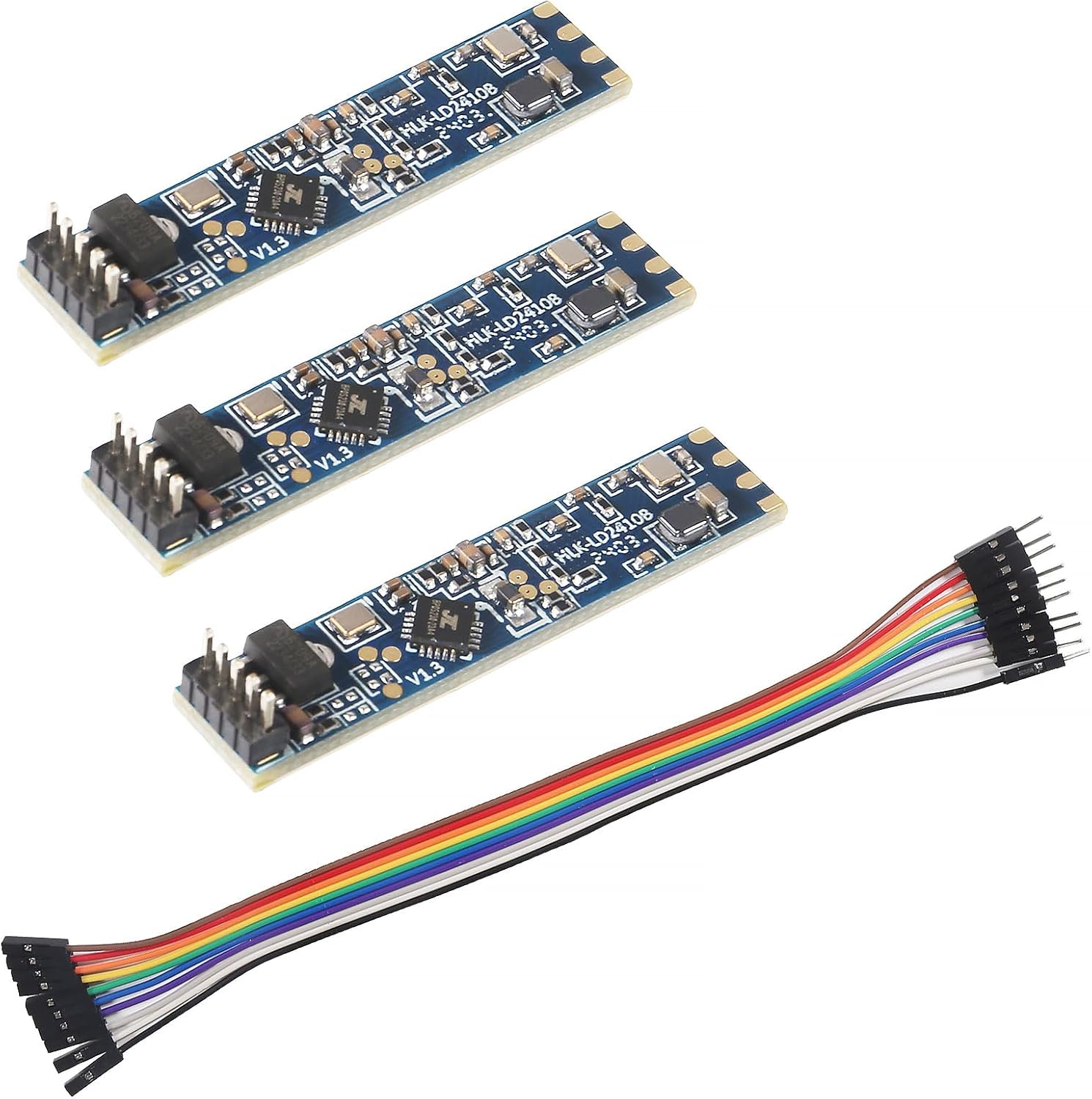
The ZORZA mini LD2420 two-pack gives you a 3.3V presence radar rated to 8m with both GPIO and UART outputs. It suits compact nodes where a 5V rail is inconvenient.
Get the moduleThe LD1125H takes a different approach from the LD2410. Instead of binary frames, it prints plain text lines over serial, reporting movement or occupancy with a distance value.
Text output is easy to read in a terminal and easy to parse in a few lines of code. In ESPHome there is no built-in component, so makers use community YAML that reads each line and splits out the state and distance. Thresholds are set by sending text commands back to the module.
For a first presence sensor, the LD2410's native ESPHome component and Bluetooth tuning save hours. The LD1125H suits people who enjoy writing their own glue and want to see raw output.
The LD2411S sits in a similar corner of Hi-Link's range: a small, low-cost module aimed at motion and micro-motion switching. If holding presence on a motionless person is your goal, check its stationary-detection figures in the datasheet before choosing it over the LD2410, which Hi-Link designed around still detection from the start.
LD2410C single module |
LD2410C 3-pack |
LD2410B Bluetooth module |
LD2410S low-power module | |
| Type | Module | Module | Module | Module |
| Version | LD2410C | LD2410C | LD2410B | LD2410S |
| Pack | 1 module | 3-pack | 3-pack | 1 module |
| Bluetooth | Yes | Yes | Yes | — |
| Cable | — | — | Yes | — |
| Get the module | Get the module | Get the module | Get the module |
The MR24HPC1 is Seeed Studio's 24GHz human static presence module. It is not a Hi-Link part, but it competes for the same job, and ESPHome has a dedicated seeed_mr24hpc1 component for it.
Its strongest card is documentation. Seeed publishes wiki pages, Arduino examples and Home Assistant guides for its radar kits, and pairs them with its XIAO boards. The module runs from 5V like the LD2410.
The whole field, one line per board:
If you are still deciding between presence and tracking, the LD2410 vs LD2450 comparison covers position radar. For picking between LD2410 versions, go to the B, C and S comparison.
Both detect still and moving people at 24GHz. The LD2420 is smaller, runs on 3.3V at 115200 baud on current firmware and has no Bluetooth; the LD2410 uses 5V at 256000 baud and the B and C tune from a phone.
It is newer with longer rated reach. For rooms under 5m the LD2410 does the same job with a larger ecosystem.
The LD2410, thanks to its native ESPHome component and Bluetooth tuning. The LD1125H outputs text that you parse yourself.
Yes, through the seeed_mr24hpc1 component. It is Seeed's module, not Hi-Link's, and runs from 5V.
Usually the firmware version: 1.5.3 and newer use 115200 baud and a different TX pin than older modules. Check the version against ESPHome's ld2420 page and confirm 3.3V power.
Best LD2410