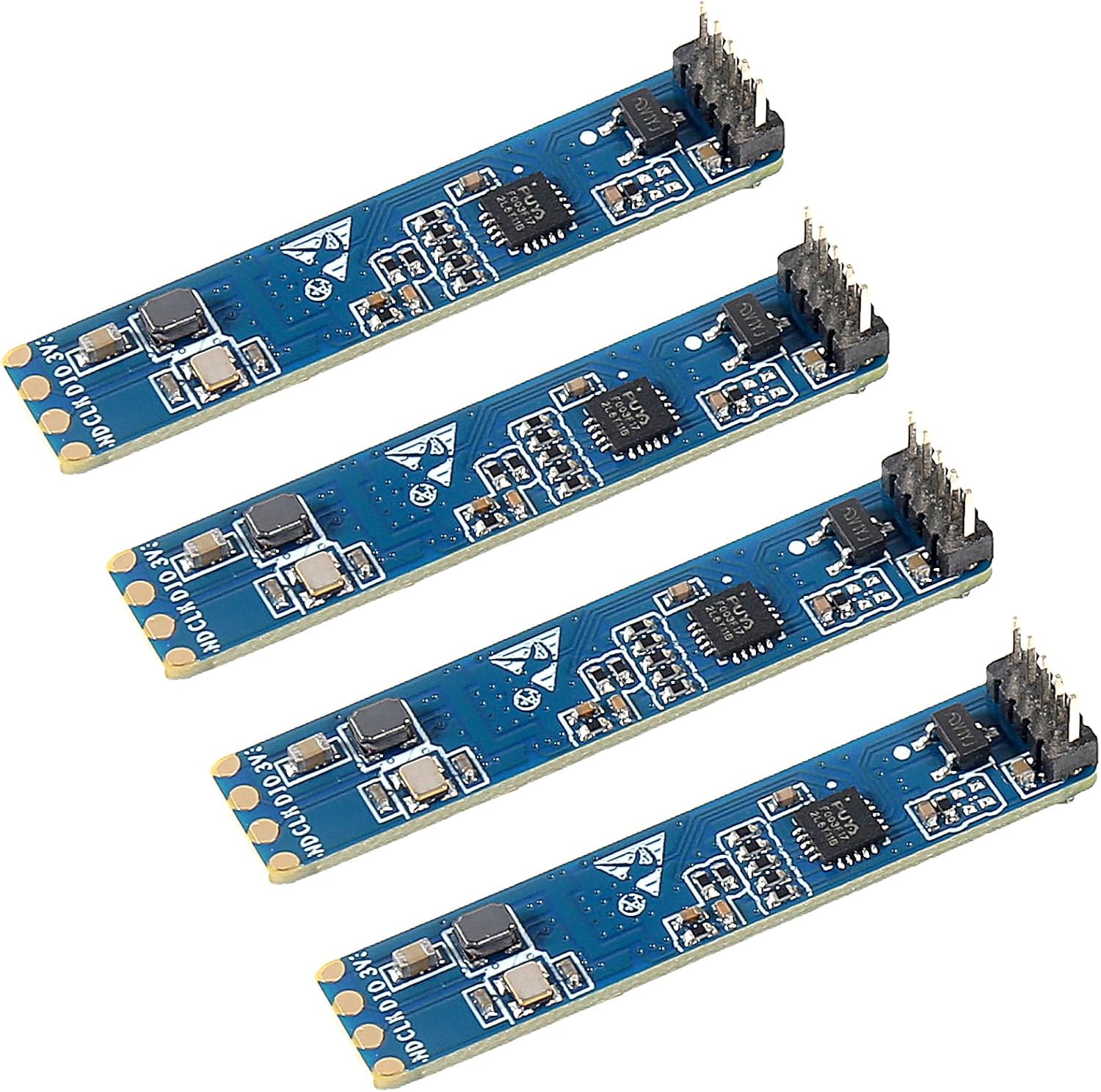
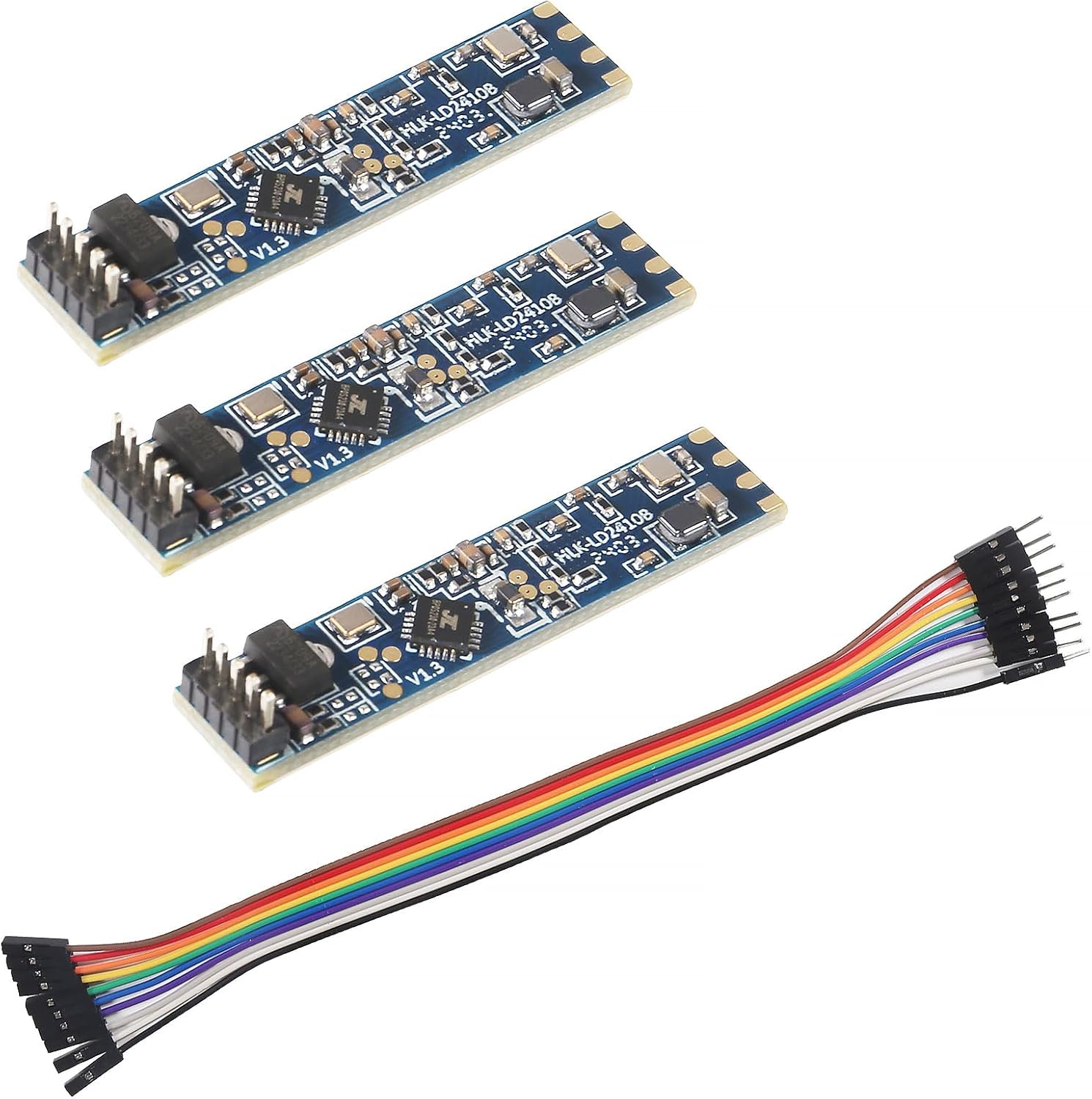
- LD2410C · 3-pack
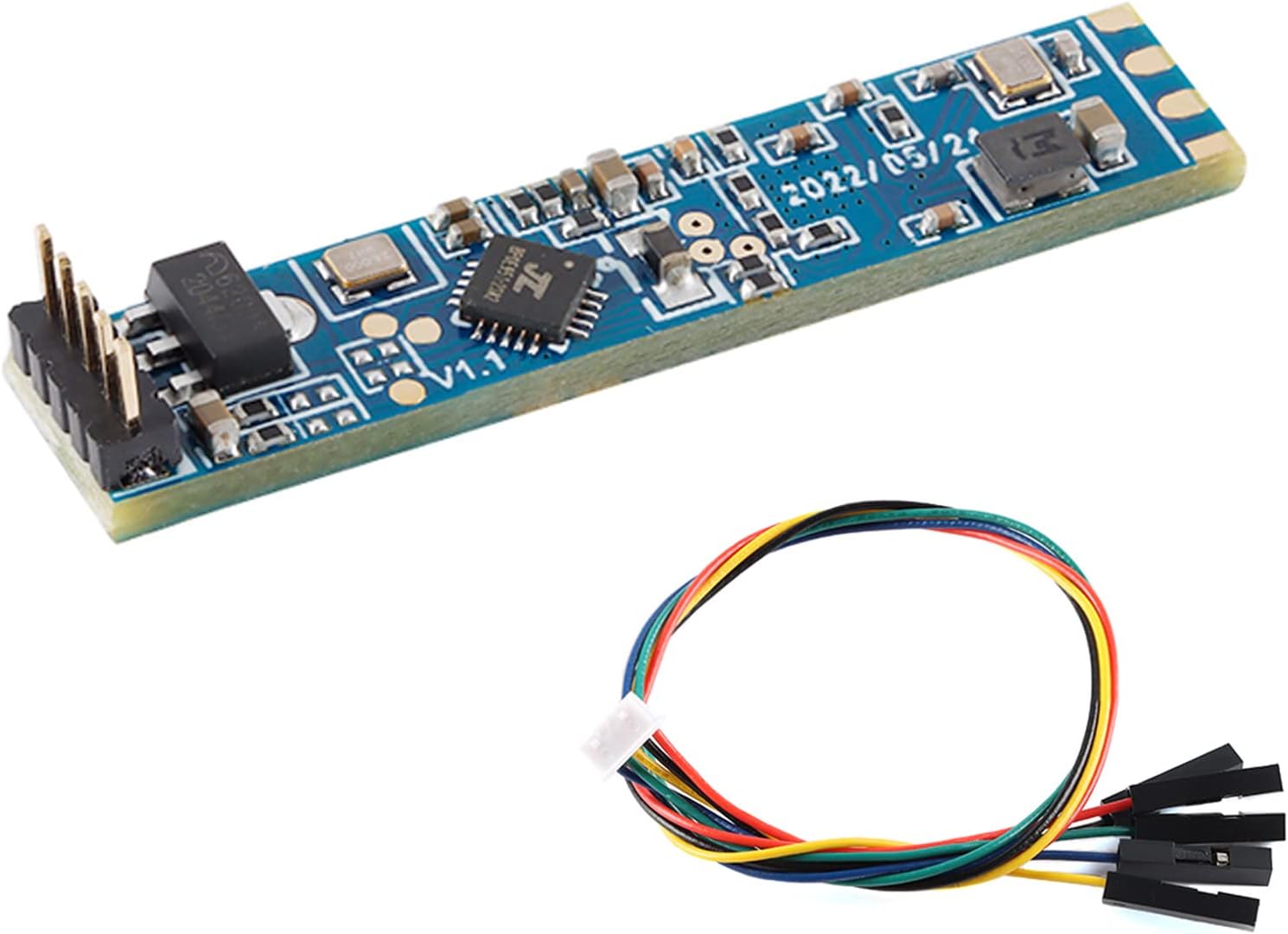
- Bluetooth: tune it from your phone
- 24GHz radar: sees people sitting still
The LD2410 is rated to about 5m in a ±60° cone, sliced into 0.75m distance gates. Knowing how that cone and those gates sit in your room is most of the tuning job.
Revised September 2026Hi-Link rates the LD2410 to 5m for a moving person and lists 0.75–6m as the adjustable range, with a ±60° detection angle. Range is split into nine gates of 0.75m each (or 0.2m on newer firmware), and each gate gets its own sensitivity. Foil or a metal plate behind and beside the module cuts the back lobe and narrows the beam.
Hi-Link's headline figure for the LD2410 is 5m, and its spec table lists the detection distance as 0.75–6m, adjustable. Both numbers describe a person moving through the beam, the easiest target a radar gets.
A person sitting still is harder. The radar picks up breathing and small shifts, which reflect far less energy than a walking body, and Hi-Link's own coverage diagrams draw the sitting zone noticeably smaller than the moving one. Plan for reliable still detection over a shorter distance than the headline.
Distance itself is reported with the 0.75m physical resolution of the radar, refined by the module's algorithm. Treat the distance value as a band, not a tape-measure reading. For precise positions you need a tracking radar such as the LD2450.
If 5m is not enough, the family has longer-reach members. The LD2410S is rated to 8m for movement, the LD2410D to 6m on a wall, and the LD2410-AA to 9m.
| Gate | At 0.75m resolution | At 0.2m resolution |
|---|---|---|
| 0 | 0–0.75m | 0–0.2m |
| 1 | 0.75–1.5m | 0.2–0.4m |
| 2 | 1.5–2.25m | 0.4–0.6m |
| 3 | 2.25–3.0m | 0.6–0.8m |
| 4 | 3.0–3.75m | 0.8–1.0m |
| 5 | 3.75–4.5m | 1.0–1.2m |
| 6 | 4.5–5.25m | 1.2–1.4m |
| 7 | 5.25–6.0m | 1.4–1.6m |
| 8 | 6.0m and beyond | 1.6–1.8m |
Approximate bands built from the gate size. Hi-Link's own examples place boundaries up to one gate apart, and body size and posture shift readings, so confirm edges by walking them in engineering mode.
The LD2410's detection angle is ±60°, a cone 120° wide in front of the board. Hi-Link shows two standard mounts: on a wall at 1.5–2m, and on a ceiling at 2.6–3m looking down.
The antennas are patches printed on the module's own circuit board, and the radar looks out of the antenna side. Mount the module with that side facing the room and nothing metal in front of it. A small tilt down on a wall mount keeps the beam off the ceiling and aims it at seated heads and chests.
Edges of the cone are weaker than the middle. A person sitting at 55° off axis and 4m away is at the very limit of both angle and still-detection range, so put the chair or bed you care about nearer the centre line.
The D and AA versions come with their own ceiling guidance: the D covers a cone with a 4m base radius from a 3m ceiling, and the AA is rated for ceilings up to 6m.
LD2410C 3-pack |
LD2410S low-power module |
LD2410D module |
JMT LD2410-AA module |
LD2410B Bluetooth module | |
| Type | Module | Module | Module | Test kit | Module |
| Version | LD2410C | LD2410S | LD2410D | LD2410-AA | LD2410B |
| Pack | 3-pack | 1 module | 4-pack | 1 module | 3-pack |
| Bluetooth | Yes | — | — | — | Yes |
| Cable | — | — | — | — | Yes |
| Get the module | Get the module | Get the module | Get the module | Get the module |
Range is divided into nine gates, numbered 0 to 8, each about 0.75m deep. Every gate has its own move threshold and still threshold, and you can cap the farthest gate for moving and for still targets separately.
Those gates are the LD2410's only zones. They are rings of distance around the sensor, not areas on a floor plan, so the module cannot tell a person on the left of the room from one on the right at the same distance.
Newer firmware adds a 0.2m distance resolution. All nine gates then fit into roughly the first 1.8m, which suits a single desk, a chair or a bathroom sink but not a whole room. Switch it from the app or the ESPHome distance_resolution select, then redo the thresholds.
If you need real zones, such as a sofa area and a kitchen area in one open room, look at the LD2450, which reports x/y positions, or finished sensors with zone settings. Per-gate tuning in Home Assistant is set out step by step in the ESPHome engineering-mode section.
The JMT LD2410-AA test kit is described for ceiling mounts up to 6m and moving targets to 9m, with UART and GPIO outputs. It suits warehouses, halls and stairwells where a standard module runs out of reach.
Get the moduleBecause the LD2410's antennas are simple printed patches, the beam is wide and the board radiates a little backwards too. Metal around the module shapes that pattern, and Hi-Link itself suggests a metal backplane to suppress the back lobe.
Shielding is empirical. The result depends on the foil's size, its distance from the antennas and the enclosure, so change one thing at a time and watch the gate energy. Never cover the antenna face with metal; that blinds the sensor.
If your enclosure is printed, the foil can go inside the back wall. The case guide covers wall thickness and spacing in front of the radar.
Most false presence on an LD2410 comes from something that moves but is not a person. Hi-Link's installation notes list the usual suspects, and each has a gate-level fix.
| Source | What you see | Fix |
|---|---|---|
| Ceiling or desk fan | Move energy in one gate, all day | Raise that gate's move threshold |
| Curtain in a draught | Intermittent moving target | Raise the gate's threshold or re-aim |
| Plants by an air vent | Small still energy | Raise the still threshold for that gate |
| Next room through drywall | Far gates light up | Lower the maximum gates, shield the back |
| Module wobbling on its mount | Random triggers everywhere | Fix it firmly |
Tune by watching real energy values, not by guessing. The HLKRadarTool app shows them live on a Bluetooth board. Set thresholds a margin above the empty-room peaks and the sensor stays quiet until someone walks in.
Hi-Link rates it to 5m for a moving person and lists 0.75–6m as adjustable. Still people register over a shorter distance.
±60°, a 120° cone in front of the antenna side of the board. The edges are weaker than the centre.
Distance bands of about 0.75m each, numbered 0 to 8, each with its own move and still sensitivity. Newer firmware can shrink them to 0.2m.
Only distance zones, through its gates. It has no angle information, so for left or right areas use a tracking sensor such as the LD2450.
Patch antennas printed on its own circuit board. That is why it needs a clear, metal-free view in front and benefits from shielding behind.
Best LD2410