- LD2410C · 1 module
- Bluetooth: tune it from your phone
- 24GHz radar: sees people sitting still
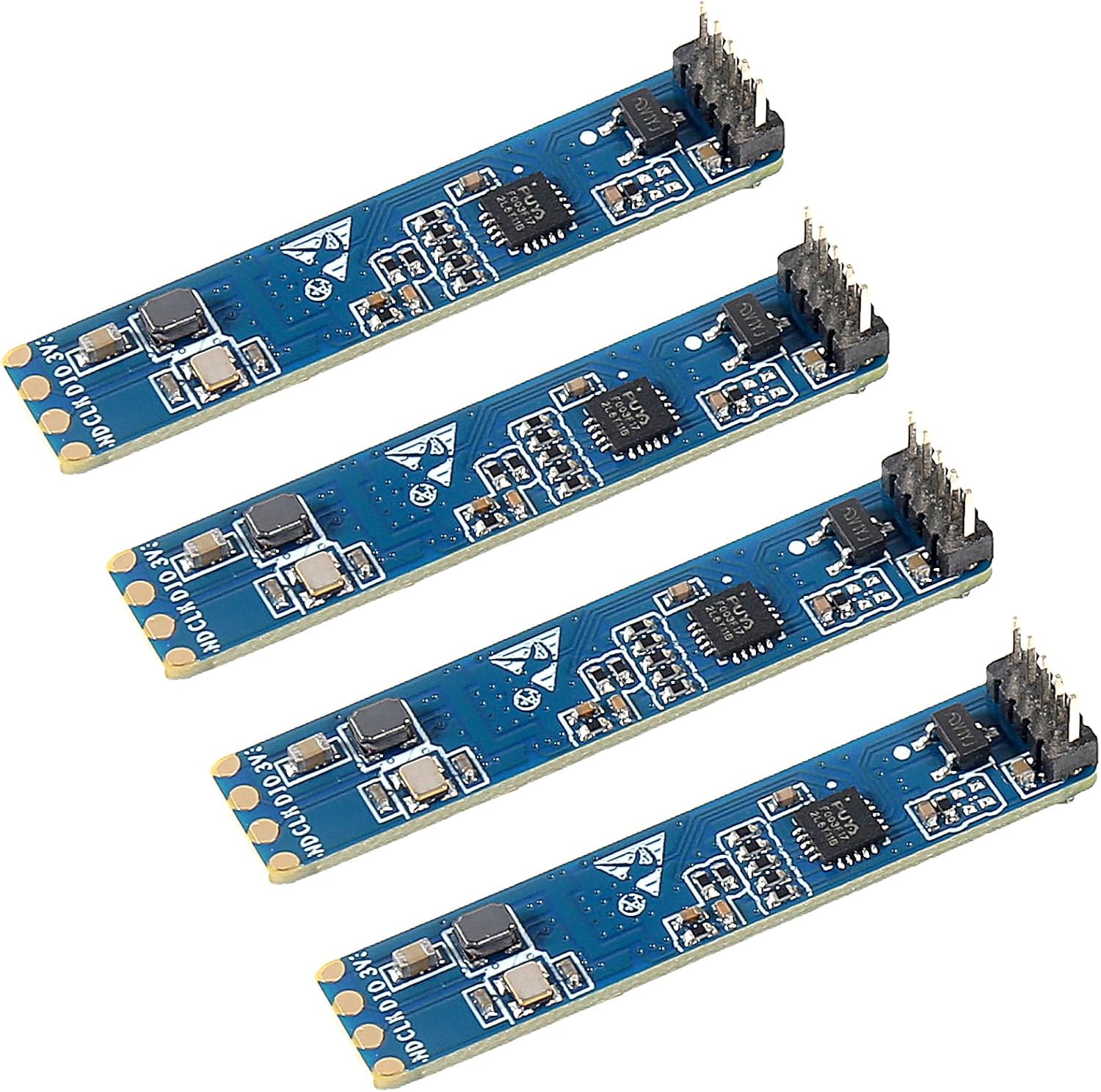
The long-reach LD2410: a stationary presence radar that sees moving people to 9m, works from ceilings as high as 6m, and lets you set the trigger and hold thresholds apart.
Most of the LD2410 family tops out around 5 or 6m. The HLK-LD2410-AA reaches 9m for moving people, which changes what one sensor can watch. A long living room, a hall, a classroom-sized space or an open-plan kitchen and dining area fits inside its reach.
Like the D, the AA is a stationary presence sensor. Its hardware is minimal and its firmware is built around micro-motion, so it reports three states of a person in the room:
The 9m figure is for moving people. Detecting someone completely still depends on the micro-motion signal, which is weaker than the return from a walking body, so the dependable range for rest is shorter. Plan the room around the spots where people sit, and check those with the sensor in place.
| Module | Moving range | Ceiling mount |
|---|---|---|
| LD2410-AA | Up to 9m | Up to 6m high |
| LD2410D | Up to 6m on a wall | 3m, 4m-radius cone |
| LD2410C | Up to 5m | Supported |
Where the extra reach earns its keep:
| Spec | Value |
|---|---|
| Model | HLK-LD2410-AA |
| Format | Test kit, 1 unit |
| Frequency band | 24GHz |
| Sensor type | Stationary human presence sensor |
| Detects | Physical activity, slight movement and rest |
| Maximum range, moving people | 9m |
| Ceiling mounting | Up to 6m height |
| Wall mounting | Supported |
| Interfaces | GPIO and UART |
| Configuration | Multi-level parameters via Bluetooth or serial port |
| Trigger and hold | Configured independently |
| Interference | Anti-interference design |
| Environment | Indoor |
| Kit dimensions | 1 × 1.64 × 0.3in (D × W × H) |
The AA supports ceiling mounting at heights up to 6m while keeping detection stable, and wall mounting as well. That covers double-height living rooms, stairwells, atriums and warehouse-style spaces where a 3m-rated sensor is simply too far from the floor.
Mounting choices by space:
At height, the distance from sensor to person grows fast. Someone sitting on a sofa under a 5m ceiling is already around 4m from the radar before any sideways distance, so the AA's reach is what makes a high mount practical at all.
Installation habits that avoid false presence:
How cone angle and distance combine is explained on range and field of view. For a case that fits a ceiling rose or a surface box, see the LD2410 case notes.
The AA configures its trigger and hold states independently. The trigger threshold decides how strong a signal must be to switch the room from empty to occupied. The hold threshold decides how weak the signal can become before an occupied room is declared empty.
That split fixes the classic presence-sensor dilemma. With a single threshold, a setting sensitive enough to hold a still reader also triggers on a fan or a curtain; a setting strict enough to ignore the fan drops the reader. Separate values let you ask for a clear signal to start presence and accept a faint one to keep it.
The AA takes these settings over Bluetooth or the serial port, with multi-level parameter adjustment for changing scenes. A sensible order:
Do not assume the AA speaks the LD2410C's command set. Check the frame format and baud rate against Hi-Link's LD2410-AA manual before pointing an existing library or the stock ESPHome ld2410 component at it. The GPIO output needs no protocol at all, so it is the quickest way into Home Assistant while you work out the UART.
For the configurator, open the HLKRadarTool and PC tool notes; confirm the tool version supports the AA before you connect.
The AA arrives as a single test kit, which suits its role: a module to evaluate in your space before you design around it. It is the right choice when reach or ceiling height rules out the rest of the family, and more than you need in an ordinary bedroom.
Choose the AA when:
Choose something else when:
Before you commit a design to the AA, use the kit to settle three things: that the moving range and the still range both reach your seats, that the ceiling height you plan works in your space, and that your software can read its UART or GPIO output. Once those pass, the design is ready.
| Question | How the kit answers it |
|---|---|
| Does it reach the far seat? | Sit there still and watch the hold state |
| Does the high mount work? | Hold it at height and walk the floor |
| Can my firmware read it? | Log UART frames and compare with the manual |
Family figures side by side are on the datasheet summary, and the main versions are compared on the version comparison. For raw position tracking across a big room, compare the LD2410 and LD2450.
Up to 9m for moving people. Detecting someone completely still relies on micro-motion, so that range is shorter in practice.
On ceilings up to 6m high, with stable detection. Wall mounting is also supported.
Trigger sets how strong a signal must be to start presence; hold sets how faint it can get before presence ends. The AA sets them independently.
Do not assume it. Check its protocol against the AA manual first, or start with its GPIO output as a binary sensor.
Best LD2410