- LD2410C · 1 module
- Bluetooth: tune it from your phone
- 24GHz radar: sees people sitting still
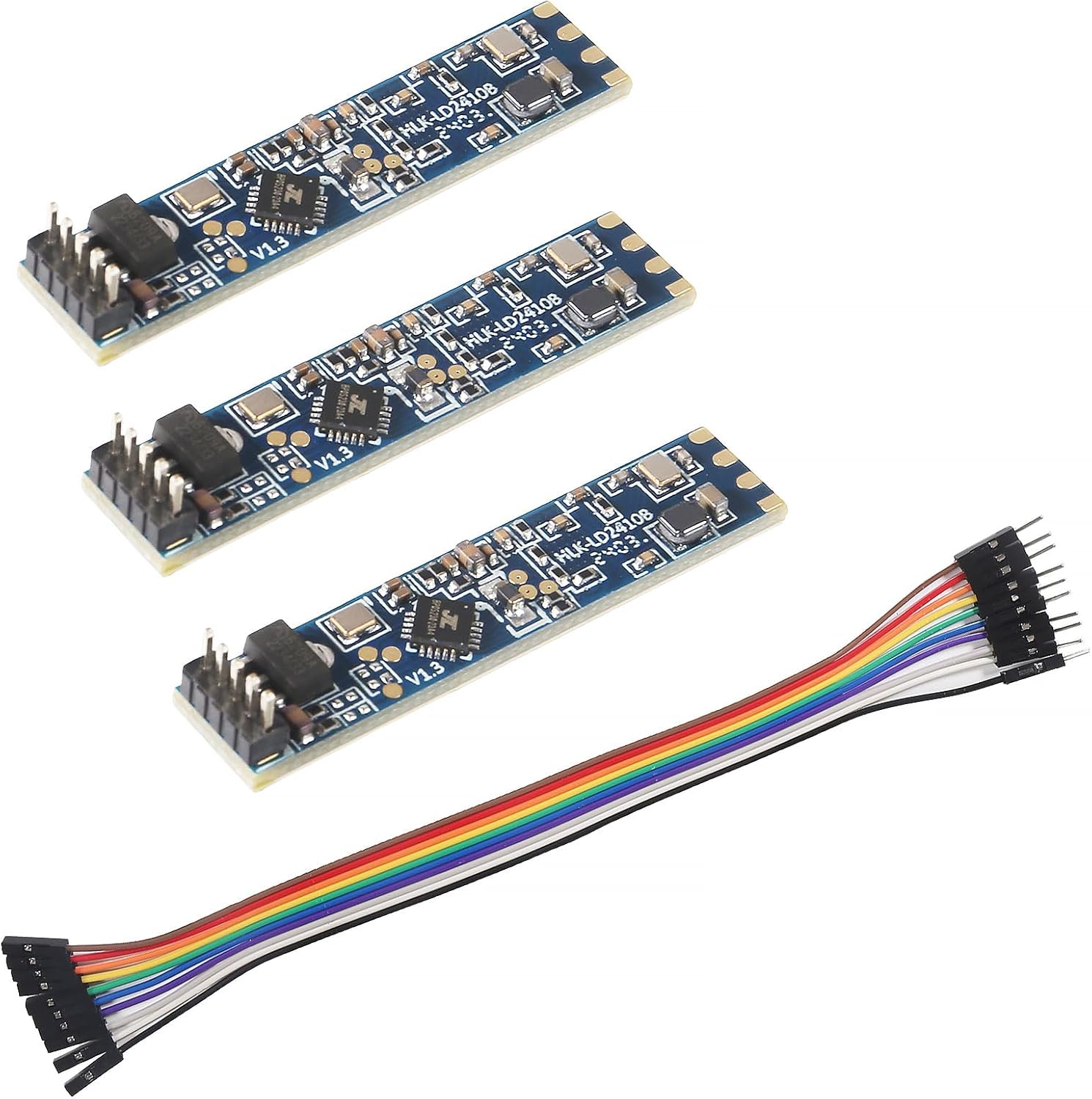
The board that started the family: the same presence radar the B and C use, on a 7 × 35mm strip with fine-pitch pins and no Bluetooth, tuned over the serial port.
The HLK-LD2410 is where the family began. It is a 7 × 35mm strip carrying a 24GHz radar that sees people moving, sitting and lying still, measures their distance, and reports over a 3.3V serial port. Everything after it, the B, the C, the B-P, is this radar with something added.
What the original has:
What it lacks:
The radar copes well with its surroundings. Temperature, brightness, humidity and light changes do not trip it the way they trip a PIR sensor, and it works from inside a plastic shell with no hole in the front. That makes it good for a sealed product that gets configured once at the bench and never touched again.
Being radio-free has a quiet advantage too. Nobody nearby can open an app and change your thresholds, and there is no second transmitter on the board sharing the supply. For a sensor inside a finished product, that is one less thing to lock down.
| Spec | Value |
|---|---|
| Model | HLK-LD2410 |
| Frequency band | 24GHz ISM |
| Radar type | FMCW |
| Detects | Moving, still, micro-motion, sitting and lying people |
| Maximum sensing distance | 5m |
| Distance resolution | 0.75m per gate |
| Coverage | Up to 60° |
| Board size | 7 × 35mm |
| Supply voltage | 5V |
| Logic level | 3.3V UART and OUT pin |
| Interfaces | UART and GPIO (OUT pin) |
| Default baud rate | 256000, 8N1 |
| Bluetooth | No on the first-generation board |
| Configurable | Farthest distance and per-gate sensitivity |
| Environment | Unaffected by temperature, brightness, humidity and light changes |
| Enclosure | Senses through a plastic shell, no window needed |
| Included with cable version | 1.25mm-to-2.54mm Dupont cable |
| Pack options | 1, 2 or 10 modules |
The original's pins sit too close together for Dupont jumpers, so the version with the 1.25mm-to-2.54mm cable is the practical buy for bench work. One end clips onto the module; the other end gives you standard female Dupont sockets for an ESP32, a USB-serial adapter or a breadboard.
Wire colours on these cables are not standardised, so never wire by colour alone. Match each wire to the pad names on your module's silkscreen, and confirm against the LD2410 pinout before power goes on.
For a permanent install, you can cut the cable and solder the fine-pitch end's wires to your carrier board. That keeps the module removable at its own connector while losing the loose Dupont ends. Board-by-board UART pins for the ESP32, ESP32-C3, D1 Mini and Arduino are on the wiring page.
With no Bluetooth, the original is tuned from a computer or from your own firmware. The usual route is a 3.3V USB-serial adapter, such as a CH340 or CP2102 board, and Hi-Link's PC configurator. The settings you write are stored on the module and survive power cuts.
You can also skip the PC entirely. ESPHome's ld2410 component exposes the gate thresholds, maximum gates and timeout as number entities, so you can tune from Home Assistant with the module already mounted. A minimal start:
uart:
rx_pin: GPIO16
tx_pin: GPIO17
baud_rate: 256000
parity: NONE
stop_bits: 1
ld2410:
binary_sensor:
- platform: ld2410
has_target:
name: PresenceThe full YAML, with thresholds and engineering mode, is on the ESPHome page, and tool downloads are on the LD2410 Tool page.
Frequent reasons the tool will not connect:
If you lose track of a changed baud rate, step through the common rates in the tool until the module answers, then set it back to 256000 so every guide and library matches.
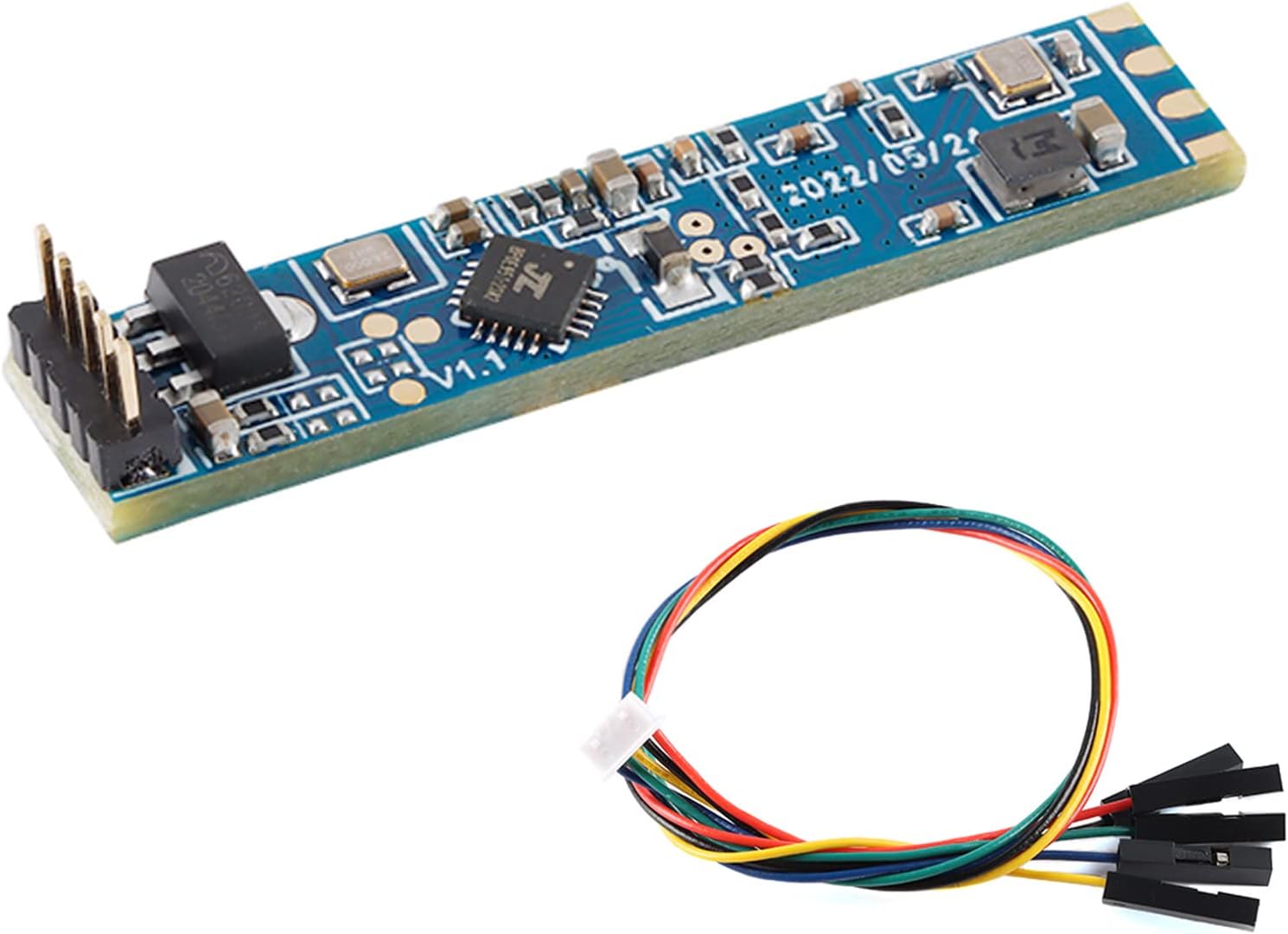
Boards sold under the plain LD2410 name come in five forms: a single with the Dupont adapter cable, bare singles, two boards marked with Bluetooth and a horizontal or vertical connector, and a multi-quantity pack of two or ten pieces. They are not all the same hardware.
The first-generation LD2410 has no Bluetooth radio. A board described as an LD2410 with Bluetooth is B-generation hardware under the family name. That is not a bad thing, since you gain phone tuning, but it changes which one you want.
| Version | Bluetooth | Pick it for |
|---|---|---|
| Single with Dupont cable | No | Bench work on the original with no soldering |
| Bare single | No | Soldering to a carrier board |
| Bluetooth, horizontal connector | Yes | Mounting flat against a board |
| Bluetooth, vertical connector | Yes | Standing upright on a header |
| 2 or 10 pieces | No | Several rooms or a small run |
The horizontal and vertical boards differ only in how the connector leaves the board. Horizontal suits a module lying flat behind a cover; vertical suits a module standing on a carrier PCB with the antenna facing the room.
Pull the board out of the bag and check:
The full family comparison, including the S and the C, is on LD2410 vs LD2410C vs LD2410B vs LD2410S, and the datasheet summary lists the original's electrical figures.
No. The first-generation board is configured over UART only. The LD2410B and LD2410C added Bluetooth.
Yes. It uses the same 256000-baud protocol as the B and C, so the ld2410 component works; only the Bluetooth switch has nothing to control.
A 1.25mm-to-2.54mm Dupont cable bridges its fine-pitch connector to standard jumpers. One version ships with it.
For a new build, the C is easier: 2.54mm pins and Bluetooth. The original suits existing designs built around its footprint.
Best LD2410