Top modules
24GHz presence radar · 7 × 35mm · Bluetooth

LD2410B Bluetooth Module

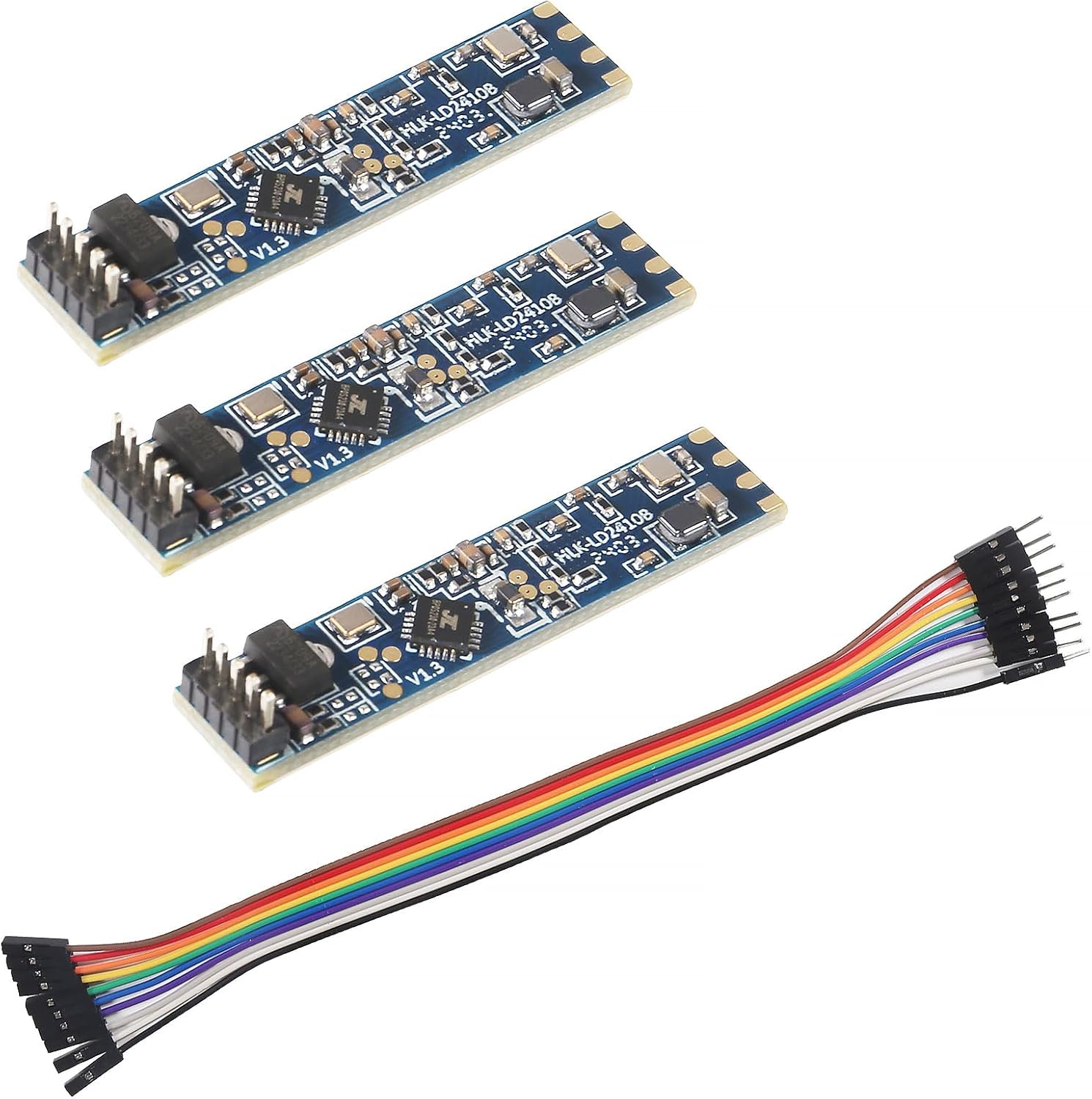
The slim LD2410: a 7 × 35mm strip that hides inside switch plates, lamp bases and ceiling roses, with Bluetooth so you can tune it after it is sealed in.

  • VersionHLK-LD2410B
  • Board7 × 35mm strip, fine-pitch pads
  • Radar24GHz, moving and still people
  • RangeUp to 5m, ±60° coverage
  • TuningBluetooth app or serial port
  • Packs1, 3 (with pins and cable) or 20
Great for
  • The radar has to fit a narrow slot or a slim case
  • You want to re-tune it after it is built in
  • You are comfortable with a fine soldering tip
Not for
  • Breadboard work with plain jumpers: the LD2410C has 2.54mm pins
  • Battery power: the LD2410S is the low-power version
Get the module
Pack sizes

Single, three or a bag of twenty

Fit the radar into a 7mm-wide slot

The LD2410B is the long, thin member of the family: a 7 × 35mm strip with the antenna patches along its length and the connection pads at one end. That shape is the point. It slides behind a light-switch plate, along the stem of a lamp, or into a 3D-printed case barely wider than a pencil.

Electrically it matches the C. The same 24GHz radar sees people moving and sitting still, reports target distance, and talks over a 3.3V UART at 256000 baud. The same Bluetooth radio lets the HLKRadarTool app connect, so you can adjust it after the case is closed. The B came first; the C later moved the same design onto a board with a breadboard header.

What the strip gives up:

  • Pin pitch. The pads sit at a fine pitch, about half of breadboard spacing. Plain Dupont jumpers will not push on.
  • Mechanical grip. A long, thin board flexes. Support it along its length, not just at the connector.
  • Margin for error. Pads are small and close, so a heavy soldering tip bridges them easily.

What it gains is placement freedom. Radar does not need a window: 24GHz passes through thin plastic, wood veneer and plasterboard trim, so the strip can hide completely behind a cover. Metal is the exception, and a metal backbox or foil tape in front of the antenna blinds it.

Code, YAML and apps written for the LD2410C work on the B unchanged. The only differences you handle are the board shape and the connector. Compare both on LD2410B vs LD2410C.
Datasheet

Board details

SpecValue
ModelHLK-LD2410B
Frequency band24GHz ISM
Radar typeFMCW
DetectsMoving and stationary people, with target distance
Maximum sensing distance5m
Distance resolution0.75m per gate
Coverage±60°
Board size7 × 35mm
Supply voltage5V
Logic level3.3V UART and OUT pin
InterfacesUART and GPIO (OUT pin)
Default baud rate256000, 8N1
BluetoothYes, app configuration
Range divisionPer-gate sensitivity; shields zones outside the set range
MountingCeiling or wall
3-pack contents3 modules with pins, 10-pin 20cm cable
Pack options1, 3 or 20 modules

Solder the fine-pitch pads without bridging

The 3-pack arrives with pins and a 10-pin, 20cm cable, which turns the hardest part of the B into a plug-in job. If yours came bare, you have two routes: solder thin wires straight to the pads, or fit a matching fine-pitch header. Either way, five connections matter: 5V, GND, TX, RX and OUT.

  1. Tin the pads lightly with a fine conical or chisel tip and a little flux.
  2. Use 28 or 30 AWG silicone wire; stiff solid-core wire levers the pads off.
  3. Tack each wire, then check with a loupe for bridges before you move on.
  4. Anchor the wires to the board with a dab of hot glue or Kapton tape as strain relief.
  5. Test continuity pad-to-pad; neighbouring pads must read open.

Then wire it like any LD2410: module TX to your microcontroller's RX, module RX to its TX, 5V and ground from the board. The UART runs at 3.3V logic, so an ESP32 or ESP32-C3 connects directly. The pinout page has the pad order and power figures, and ESP32 and Arduino wiring covers each board's UART pins.

Pick your wiring by where the strip is going:

  • Permanent install in a switch box: soldered wires, strain relief, heatshrink over the joint.
  • Bench experiments: the supplied cable, or a fine-pitch-to-2.54mm adapter.
  • Swappable module in a case: a fine-pitch header on the board and a matching socket on your carrier.

Want to leave the soldering iron cold? The LD2410B-P is the same board with pins already fitted.

Among the others

Its place in the range

LD2410 sensor models by type, September 2026. Highlighted: LD2410B Bluetooth module.

Mount it on the ceiling or the wall and set the gates to match

The B supports ceiling and wall mounting, and each one changes how you set the distance gates. The radar splits its range into 0.75m gates, gate 0 at the board and gate 8 at the far end, and gives each its own threshold for motion and stillness. Ranges outside the zone you set are ignored, which is how you keep the hallway out of the living room.

On a wall, mount the strip at around chest height with the antenna face pointing into the room. The ±60° cone then covers the floor area in front of it, and the far gates line up with the far wall. Set the maximum moving and still gates to that wall and nothing beyond it counts.

On a ceiling, the gates measure straight down and outwards. A person lying in bed is only two or three gates away, so the near gates do most of the work and the far gates can be switched off. Ceiling mounting also keeps the cone off windows and doorways.

MountAimGates that matter
Wall, chest heightAcross the roomUp to the far wall
Ceiling, room centreStraight downThe first few
Over a desk or bedAt the personOne or two, high still sensitivity

Then tune from the phone:

  • Empty the room and raise thresholds on any gate that stays lit.
  • Lower the still threshold on the gate where someone sits, so reading or sleeping holds presence.
  • Set the no-one delay long enough that a quiet minute does not switch the lights off.

Cone widths and real-world reach are laid out on range and field of view.

Swap options

Other boards to try

Breadboard-friendly pins1 LD2410C single module
LD2410C single module
The LD2410C runs the same radar and Bluetooth on a 2.54mm header that takes plain jumper wires.
  • LD2410C · 1 module
  • Bluetooth: tune it from your phone
  • 24GHz radar: sees people sitting still
Get the module
Battery-powered builds2 LD2410S low-power module
LD2410S low-power module
The LD2410S runs from 3.3V with very low current and reaches 8m for moving people.
  • LD2410S · 1 module
  • 24GHz radar: sees people sitting still
Get the module

Choose between the single, the 3-pack and the bag of twenty

The LD2410B comes as a single module, as a 3-pack with pins and a 20cm cable, and in a multi-option bundle of one or twenty pieces. The modules are the same LD2410B in each case. What changes is how many you get and whether you still have to solve the connector yourself.

  • Single module: one strip for a single room or a first build. Budget time for soldering, since it is usually bare.
  • 3-pack with pins and cable: the easiest start. The cable takes the fine pitch out of the job, and three strips cover a bedroom, office and hallway.
  • 1 or 20 pieces: for a production run or a whole-house build. The same bundle also comes as the plain HLK-LD2410, so make sure the B is the one you choose.

A spare strip earns its place with the B more than with any other version. A lifted pad or a cracked board ends that module, and it is far better to find that out with a second one on the bench than halfway through fitting a switch plate. Keep the spare in an antistatic bag, away from the soldering station.

How the B compares with the neighbours:

  • LD2410C: same radar and Bluetooth, 2.54mm header, stubbier board. Better on a breadboard.
  • LD2410B-P: the B with pins fitted. Same size, no soldering.
  • LD2410B test kit: a B with the parts to plug it into a laptop on day one.
  • Original LD2410: the same strip shape without Bluetooth, configured over serial only.
Settle on the 7 × 35mm strip with Bluetooth and a 5V supply first. For a sealed build, plan the case first with the LD2410 case notes.
Troubleshooting

Wiring questions

LD2410B or plain LD2410: what changes on the bench?

The B adds Bluetooth, so the HLKRadarTool app can tune it without wiring. The radar, protocol and 7 × 35mm strip shape are otherwise the same.

Can I use Dupont jumpers on the LD2410B?

Not directly. Its pads are fine pitch, so use the supplied 10-pin cable, an adapter, or solder thin wires to the pads.

Does ESPHome work with the LD2410B?

Yes. The ld2410 component supports the B at 256000 baud, including gate thresholds and a switch to turn Bluetooth off.

Can the LD2410B see through a case?

Yes, through thin plastic, wood and plasterboard. Metal in front of the antenna blocks it.

Best LD2410