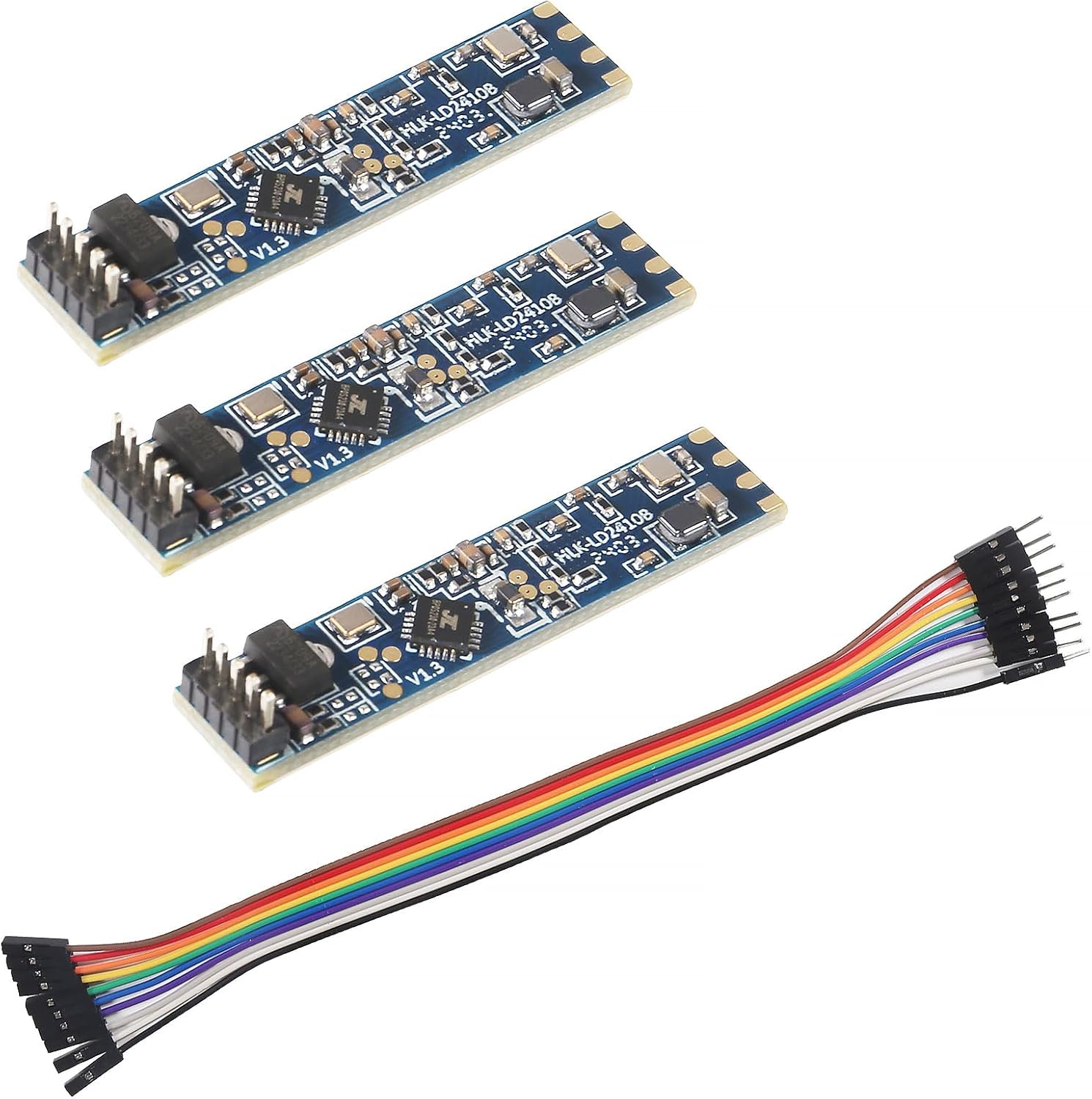
- LD2410C · 3-pack
- Bluetooth: tune it from your phone
- 24GHz radar: sees people sitting still
An LD2410B set up for the bench: connect it to a computer, watch every distance gate live, and learn the radar before you design it into anything.
The LD2410B test kit exists so your first evening with the radar goes on learning it, not on wiring it. Hi-Link's test kits pair the module with the parts needed to reach a computer over USB-serial; the exact adapter board varies from kit to kit. Plug in, open the configurator, and the radar is on screen.
The module is a standard HLK-LD2410B: 24GHz radar, 5m range, ±60° coverage and Bluetooth. That means you get two ways in from the start:
A first session worth doing:
Twenty minutes of that teaches you more about the LD2410 than any spec sheet. You see how the still-energy reading follows small movements like breathing, how a fan lights the near gates, and how far the radar reaches through a door.
| Spec | Value |
|---|---|
| Model | HLK-LD2410B |
| Kit type | Bluetooth test kit |
| Frequency band | 24GHz ISM |
| Detects | Moving and stationary people, with target distance |
| Maximum sensing distance | 5m |
| Distance resolution | 0.75m per gate |
| Measurement accuracy | ±0.375m |
| Coverage | ±60° |
| Module size | 7 × 35mm |
| Maximum supply voltage | 5V DC |
| Outputs | Digital OUT pin and UART |
| Default baud rate | 256000, 8N1 |
| Bluetooth | Yes |
| Configuration | Bluetooth or serial port; sensing range division |
| Mounting | Ceiling or wall |
| Weight | 10g |
A test kit on a laptop is the best way to see the LD2410 protocol itself. Open any serial terminal that supports 256000 baud, 8 data bits, no parity, one stop bit, and switch it to hex view. The radar streams report frames continuously.
Per Hi-Link's serial protocol document, the frames are easy to pick out:
To change settings from your own code, you wrap commands between an enable-configuration command and an end-configuration command. The same sequence is what ESPHome and the Arduino libraries send under the hood.
| Mode | What the frame carries | Use it for |
|---|---|---|
| Basic | Target state, distances, energies | Normal operation |
| Engineering | Plus energy for every gate | Tuning and debugging |
Engineering mode is where the test kit earns its keep. Log a few minutes of per-gate energy with the room empty and then occupied, and you have real numbers for your room to set thresholds from, instead of guesses.
Pin functions and power figures are on the LD2410 pinout page, and the protocol basics sit in the datasheet summary.
The kit is a bench tool, not a finished sensor. Once you know the radar, the LD2410B comes off the kit and goes into your project, or you keep the kit as a permanent tuning rig and fit fresh modules in the field. Either way, the settings you saved stay in the module.
Moving the module to an ESP32 build:
uart:
rx_pin: GPIO16
tx_pin: GPIO17
baud_rate: 256000
parity: NONE
stop_bits: 1
ld2410:
binary_sensor:
- platform: ld2410
has_target:
name: PresenceThe B's pads are fine pitch, so plan how you connect it in the final build:
Full YAML with thresholds and a Bluetooth switch is on the ESPHome page, and per-board UART pins are on the wiring page. For enclosure ideas, see LD2410 cases.
Keep the kit itself. When a mounted sensor misbehaves months later, a spare module on the kit lets you compare readings in the same room and tell a tuning problem from a faulty board.
One test kit covers a whole project. The kit gives you the laptop connection and a module to learn on; every sensor after that can be a bare board, a pinned B-P or a C in a pack. Both test kit versions carry the same HLK-LD2410B and Bluetooth.
The two test kit versions are the same kit under slightly different names; either one lands the same parts on your desk. The part that pays off is having one on the bench before the first sensor goes on a wall: a kit makes every later module faster to set up, because you already know which gates your rooms light up and which thresholds hold a still person.
What to buy after the kit, by build:
| Next build | Module | Why |
|---|---|---|
| Slim install behind a cover | LD2410B | Same board you learned on |
| No soldering, slim | LD2410B-P | Pins fitted |
| Breadboard or perfboard | LD2410C | 2.54mm header |
| Battery power | LD2410S | 3.3V, low power, own protocol |
Skip the kit if:
Take the kit if:
The version comparison, B against C and the rest, is on LD2410B vs LD2410C.
Connecting the LD2410B to a computer so you can tune it with the PC tool, watch every gate and log raw serial frames.
Yes. It is a standard HLK-LD2410B, so the HLKRadarTool phone app works alongside the serial connection.
Yes. Settings are saved on the module. Move it to your ESP32 build, or keep the kit as a tuning rig and fit new modules.
256000 baud, 8 data bits, no parity, one stop bit by default.
Best LD2410